Personalized Gift Ideas
What to do with naturally shed cat whiskers
Simple ways to keep a naturally shed cat whisker, from a labeled jar to a small display, with questions to ask before commissioning a keepsake.
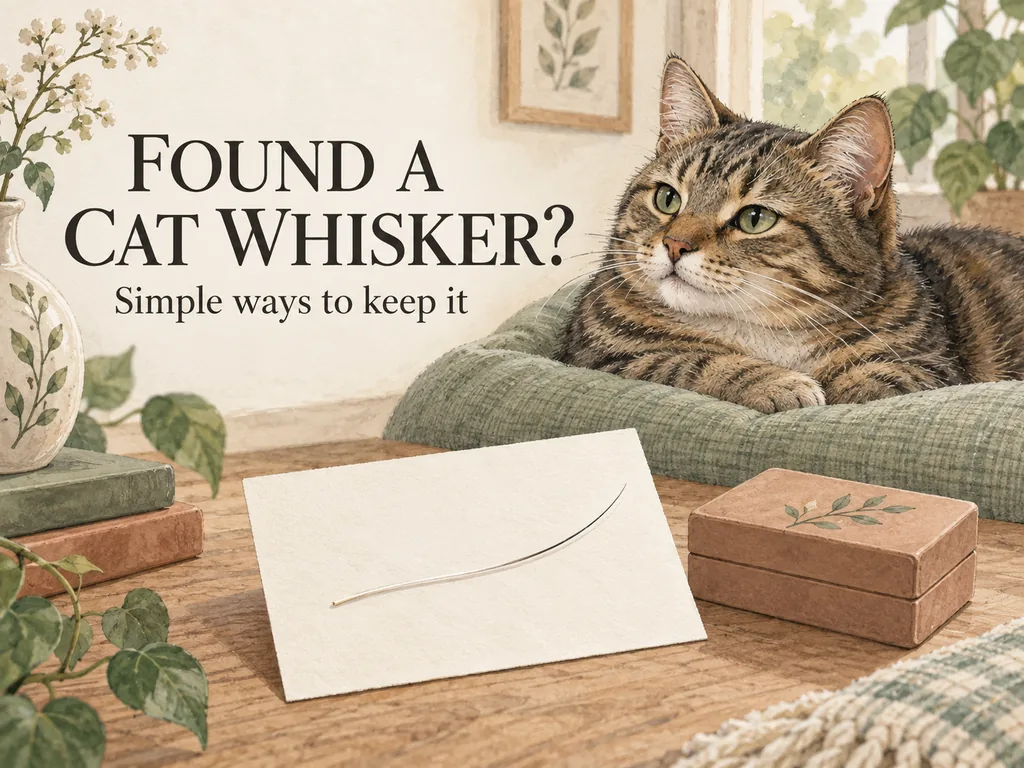
If you find a whisker your cat has naturally shed, you can keep it in a clean, dry container with a lid and add a small label. A little box works too. Choose something large enough that you do not need to bend or trim the whisker to close it.
You might spot one on a dark cushion while tidying up, then wonder where to put it before it disappears again. Start with a container you can find easily. You can decide later whether you want a display, a label, or just somewhere to keep that one small find.
Only keep whiskers your cat has already shed
Pick up whiskers you happen to find on bedding, furniture, or the floor. Do not pull, pluck, or cut them from your cat for a collection. VCA Animal Hospitals explains that whiskers are sensory tools and should be protected.
An occasional shed whisker can be normal. If your cat loses many at once, has damaged whiskers, or whiskers are not growing back, ask your veterinarian rather than treating it as a collecting opportunity. This distinction follows Cats Protection's guidance on whisker shedding. A keepsake article cannot assess a change in your cat's health.
Leave the collecting to chance. There is no reason to search your cat's face for a loose one or groom them specially to find more.
Choose storage before choosing a display
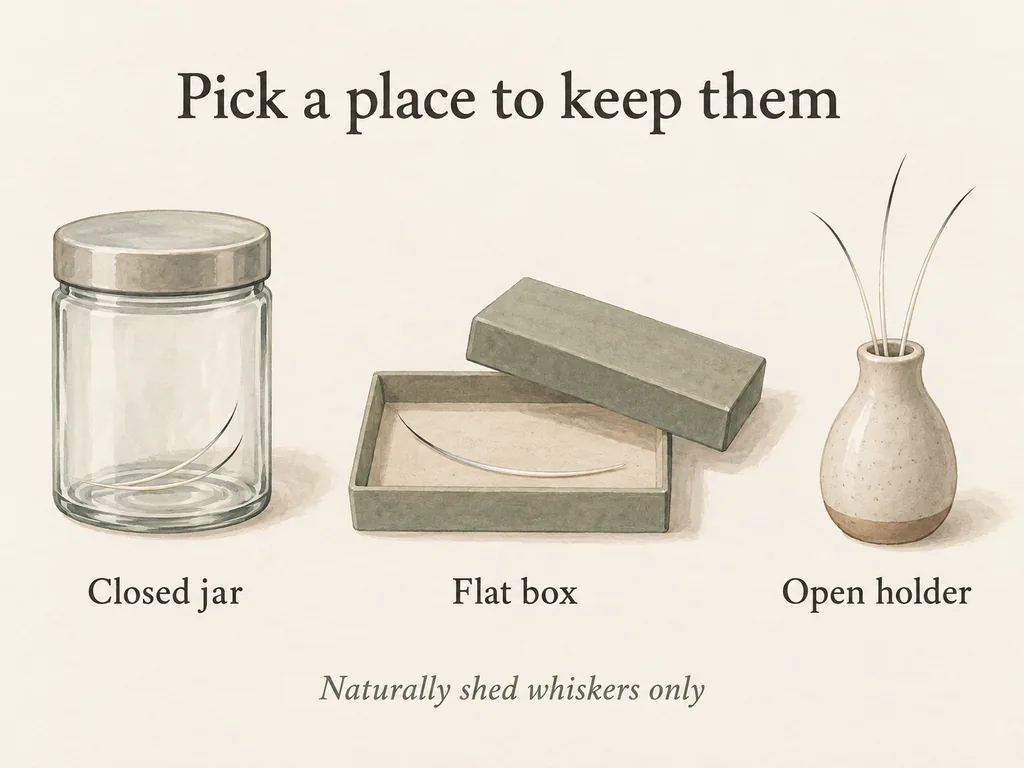
A lid is useful if you are mostly worried about losing the whisker. If you would rather see it on a shelf, an open holder might appeal more. Think about the shelf first: will the cat investigate it, or will you need to move it every time you dust?
| Format | When it might suit you | What to check |
|---|---|---|
| Small jar or vial with a lid | You want to see the whiskers while keeping them enclosed | Usable space below the lid, a stable position, and an opening you can use without forcing the whiskers in |
| Shallow box or envelope inside a box | You would rather keep them flat and put the collection away | Enough room for their natural curve; nothing heavy resting on them |
| Open whisker holder | You want a small display and have a protected place for it | Whether it tips easily, whether loose whiskers can fall out, and whether pets or children can reach it |
Measure the whisker you already have before ordering a container. A product's outside height does not tell you how much room remains inside when its lid is fitted. If it is too short, choose another container rather than forcing the whisker into a smaller shape.
These are household storage suggestions, not archival preservation instructions. A glass, wood, or ceramic container alone does not guarantee how long its contents will last.
Label the find, especially in a multi-cat home
If several cats share the sofa, you may have no idea who left the whisker there. Label it "our cats" or "cat unknown" if you want to keep it. Use an individual name when you know whose it is, rather than guessing from the color.
Record the day you found it if that matters to you. This is the finding date, not necessarily the day it fell out. If you do not know the date, leave it off.
A label might read:
Cat: [name, if known]Found: [date, if known]Place: [where you found it]
Keep the label outside the container or on a separate card. If you know the whiskers belong to different cats and want to keep them separate, label each container before adding another find. You do not have to record every whisker individually.
Give the collection a place in everyday life
Keep the container somewhere clean and dry, away from pets and young children. Loose whiskers, little lids, and glass containers are keepsake materials, not toys. A high shelf is only useful if your cat cannot get to it; a closed cupboard may suit your home better.
Avoid setting an open holder where it will be knocked over during dusting. If you keep the whiskers in a box with a tag or other objects, give the container its own space so the heavier items do not press against it. Our guide to creating a pet keepsake box covers arranging different small keepsakes together.
Perhaps the whisker turned up on the chair your cat has claimed for years. A photograph of that chair or a sentence about it can go beside the container. For more ideas, see small ways to save everyday pet memories. The jar can also stay exactly as it is.
Before ordering a custom whisker keepsake
Before you send a whisker away for a commissioned piece, ask the maker what will happen to it:
- Do they need the actual whisker, and how much material do they require?
- Will it remain removable, or will it be permanently enclosed or altered?
- What preparation and shipping instructions apply to this exact item?
- Will unused material be returned, and what happens if a parcel is lost?
Do not assume that a finished object can be opened later. If you are unwilling to risk losing your only whisker, a container you can fill yourself may be a better fit. There is no need to commit to a custom piece while you are still deciding.
For a gift, ask whether the person actually wants to collect whiskers. Do not take one from their existing collection or ask them to surrender a keepsake for a surprise order. An empty holder can still be personal if they want one. Our guide to choosing a personalized gift for a pet person has broader questions to consider before ordering.
A few common questions
Do I need a special cat whisker holder?
No. A clean, dry container you already own may be enough if it has room and closes without pressing on the whisker. A decorative holder is a choice about how you want to display it, not a requirement for collecting.
What if I have found only one whisker?
Keep the one you found. An almost-empty jar is fine; you do not need to fill it.
Can I sort my cats' whiskers by color?
If you do not know which cat a found whisker belongs to, keep that uncertainty on the label. You do not need a definite name for it to be part of your household's collection.
Is it wrong not to keep them?
No. Keeping a whisker is a personal preference. A photograph, a note, or no collection at all can suit you just as well.