
Personalized Gift Ideas
How to choose a pet memorial stone or grave marker
Start with where the stone will sit, then check permission, material, care and wording before personalizing a garden tribute or resting-place marker.

Choose a pet memorial stone by deciding what it will do and where it will sit. A decorative reminder at home, a garden tribute and a marker for a resting place have different requirements. Before ordering, check the location's permission, the actual material and finish, the dimensions and the inscription options.
You do not need an inscription ready before you start looking.
Decide whether it is a reminder or a resting-place marker
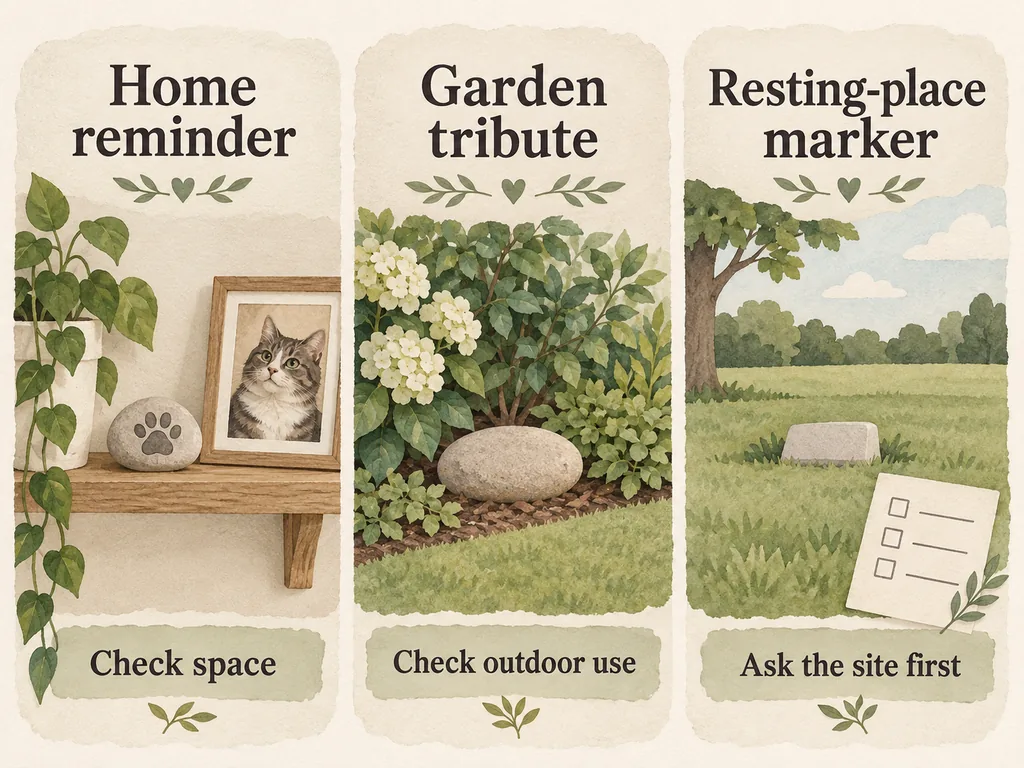
A stone does not need to mark a burial. It might sit beside a photograph on a shelf or in a garden corner where your pet liked to rest. A grave marker identifies a resting place and needs to meet that location's requirements.
Think about which of these you have in mind:
| Intended place | What you are choosing | First question |
|---|---|---|
| A shelf or table at home | A decorative keepsake | Does its size and weight suit the display space? |
| A garden tribute without a burial | A reminder in a familiar setting | Is it suitable for that spot, and is placement permitted? |
| A cemetery or other resting place | A marker for that location | What must the site approve before purchase? |
A listing may use "garden stone" and "grave marker" for the same item. Check its intended use anyway; neither name means a cemetery has approved it. If you expect to move home, it is worth thinking now about whether you want to take the keepsake with you.
Ask the destination before ordering a grave marker
If you have a cemetery plot, ask the office for the marker requirements for that section before ordering. The answer should cover the material and dimensions, any design or inscription approval, and who will install it.
For example, Rainier Cemetery District's Companion Corner, a pet cemetery in Oregon, describes a marker approval process and specifies who may set markers. Its requirements apply to that cemetery, not every place where pets are remembered.
Another Oregon location, The Forest Pet Cemetery, permits only native stones from its property as grave markers and requires approval of the engraving. These two examples show why a stone accepted at one site cannot be assumed acceptable at another.
At a rented home or shared garden, speak to whoever is responsible for the space before planning permanent placement. A permission to place a decorative stone should not be treated as permission for a burial. This guide cannot settle either question for your property.
Read the material and finish description
A stone-like surface does not tell you how the item was made. Kay Berry describes its own stone products as hand cast. That is one example of why you should read the material description instead of assuming every garden stone is cut natural stone.
What is the body made of? Is there a coating, and how is the lettering or photo applied? "Stone look" does not answer those questions. Look at the description for the selected item, rather than borrowing details from another style in the range.
Ask about the conditions at the exact spot
Describe the intended location to the seller. Is it exposed to rain, sprinklers, direct sunlight or freezing temperatures? Will the underside touch soil? These are conditions to ask about, not proof that a product can withstand them.
Look for the maker's guidance on outdoor use and any seasonal storage or placement restrictions. A broad label such as "garden memorial" is not a full set of care instructions. Avoid choosing on the strength of an unsupported claim that one material will last a fixed number of years in every setting.
For a spot exposed to rain and winter freezing, you might ask: "Would this item suit those conditions, and would I need to bring it indoors during part of the year?" A clear answer helps you decide whether that care would be practical for you.
Check the lettering and any photo panel too
The surface, inscription and photo area all need to suit the intended use. Ask whether the care instructions cover the lettering or photo insert as well as the body of the stone. Do not assume a durable-looking base makes every decorative element suitable outdoors.
If you want to clean an existing piece, use the instructions for that material and finish. Ask before applying household cleaners, abrasives or a protective coating; this guide does not prescribe a treatment for an unknown product.
Give the inscription room to be read
Write the name first. You may find that is enough. If you want a phrase too, choose something you would actually say about your pet, then check whether it fits the available space. Dates can be left out when they are uncertain or unwanted.
You could adapt one of these wording prompts:
- "[Name], our garden companion"
- "Remembering our walks with [Name]"
- "A quiet place to remember [Name]"
Use a garden or walking reference only if it matches your pet's life. For a living pet's favorite spot, a name alone may be all you need.
A long name can use much of a small inscription area. Check the character and line limits, and ask which lettering options fit the selected size. If you have more to say, keep the longer message in a card or written memory.
Check spelling, punctuation and dates against your own record. If the item is a gift, confirm the name the recipient uses and whether they want dates included. Do not invent a birth date to make the layout symmetrical.
Compare delivery, placement and care
If you have a date in mind, ask separately about personalization time, dispatch and delivery. A needed-by date is not a confirmed arrival date. For a formal marker, installation arrangements may also be separate from delivery; check with the site before assuming the two happen together.
Look up the dimensions and weight before choosing a spot. If the item needs a base or support, find out who supplies it and which instructions apply. In a garden, leave room for people to walk and for routine maintenance around the piece.
Do not infer a mounting method from a product photograph or an illustration. A heavy or upright marker needs the relevant installer or site's guidance. The same applies to moving an installed marker later.
Make the final check with the recipient or household
Before ordering, make sure the purpose and location are agreed. Someone may want a small reminder indoors rather than a marker in the garden. If the choice feels too permanent, the pet memorial ideas guide includes options that start with a photograph or a written memory.
Morylane's pet memorial stones and pet grave markers collections provide places to browse. Check the individual item against your location's requirements; a category label does not replace that comparison.
Save the material and care details with any site approval and your final wording. Before ordering, check that you know where the piece can go and what you will need to do to look after it.