Remembrance Ideas
Pet sympathy card messages for different situations
Short messages and complete pet sympathy cards to make your own, with ideas for a late note, a shared card and a memory you genuinely know.
A pet sympathy card can be two sentences: "I'm sorry about [pet's name]. I wanted to let you know I'm thinking of you." Add your name. That can be the whole card.
The messages below are original examples to adapt. Replace the brackets, keep only details you know to be true, and choose a sign-off that fits your relationship. You do not need to include a gift or find a quotation.
Start with a message that fits what you know
If you know the pet's name, check its spelling. If you do not, "your pet" is fine. A short note does not need an invented memory to make it personal.
Try one of these:
- "I'm so sorry about [Name]. Sending you care as you miss your companion."
- "I wanted to write after hearing about your pet. I'm thinking of you."
- "I'm remembering [Name] and sending my sympathy to you both."
- "There is no need to answer this card. I just wanted you to know I care."
Choose one message. Check who it addresses: "you both" is for two people, and "I'm remembering" needs a connection with the pet. Keep the no-reply line only if you mean it.
Hallmark's pet-sympathy writing guide suggests personalizing a note with the pet's name and familiar details. The details should come from what you know, not from a stock description of what dogs or cats are supposed to be like.
Three complete cards to adapt
For a close friend
Dear [friend's name],
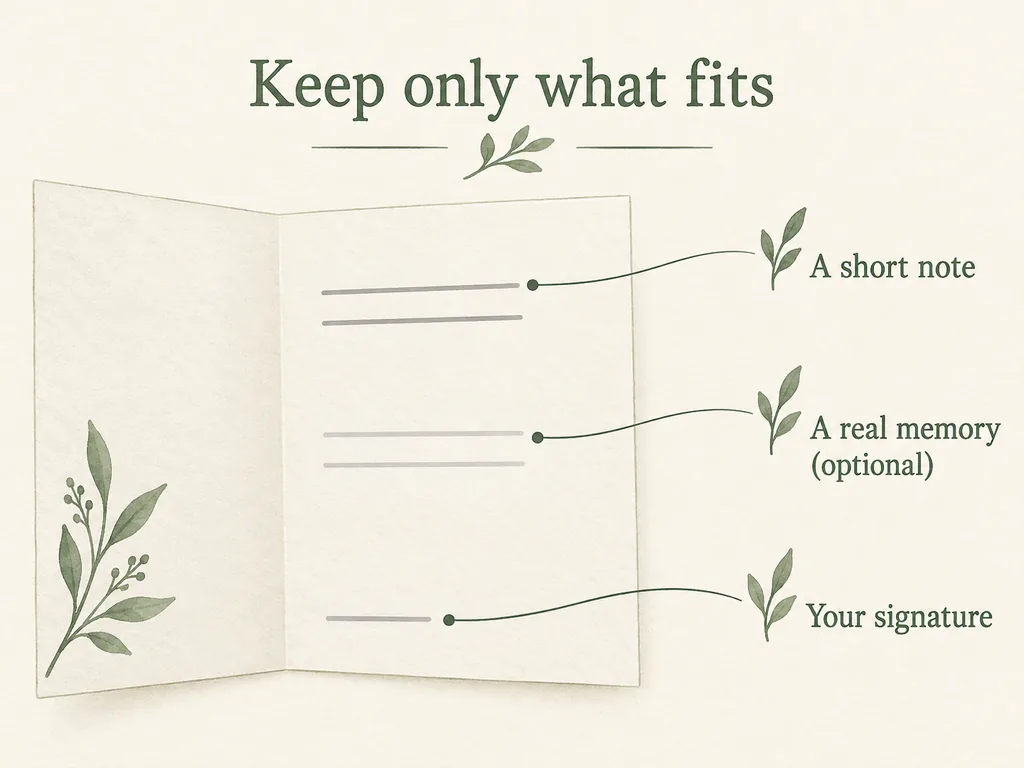
I'm sorry about [pet's name]. I've been thinking of you and wanted to send something you could read whenever you feel like it. I care about you. There's no need to write back.
With love,
[your name]
Change "With love" if it is not how you normally speak to this friend. If you want to make a practical offer, use something specific you can do and ask before arranging it.
For a coworker or acquaintance
Dear [name],
I was very sorry to hear about your pet. Please accept my sympathy. I wanted you to know that I am thinking of you.
With care,
[your name]
Add the pet's name if you know it. Keep any promise about time off, work arrangements or colleagues' help out of the card unless you have authority to offer it.
When you knew the pet
Dear [name],
I'm so sorry about [pet's name]. I keep remembering [one moment you genuinely shared]. I wanted to put that memory in writing for you. I'll remember [pet's name], too.
Thinking of you,
[your name]
Fill the memory space with a real detail: a visit, a walk or a habit you saw yourself. If you cannot think of one, use a shorter card. You do not need to make the relationship sound closer than it was.
For the loss of a dog, cat or another companion
A name can do most of the work here. These examples leave room for a dog, a cat or another companion without assigning them a personality you did not know.
For a dog:
I'm sorry about [dog's name]. I wanted to send my sympathy and let you know you're in my thoughts.
For a cat:
I'm very sorry you have had to say goodbye to [cat's name]. Sending you a note of care as you miss your cat.
For another companion:
I was sorry to hear about [pet's name]. I'm thinking of you and wanted to acknowledge your loss.
Avoid adding a habit just because it fits the species. Not every dog loved long walks, and not every cat sat on a visitor's lap. A remembered detail is useful only when it belongs to this pet.
If you heard the news later
You can acknowledge that you have only just heard without making the card about your delay:
Dear [name],
I've only just heard about [pet's name], and I'm very sorry. I wanted to write and let you know I'm thinking of you.
With sympathy,
[your name]
You do not need to ask how the death happened or whether the person is feeling better now. If you knew earlier but did not write, you could instead begin, "I've been thinking of you and wanted to send this note." Keep any apology for writing late brief.
When several people sign one card
Before passing a card around, consider who knows about the loss. If the person told only you, ask before involving colleagues or friends. You can always send your own note.
For a group whose members have agreed to take part:
We wanted to send our sympathy after hearing about [pet's name]. We're thinking of you and hope this note lets you know we care.
[Names of the people who chose to sign]
Do not fill in other people's signatures for them or promise that "we" will provide help everyone has not agreed to. Leave room for individual notes, and give the card privately rather than requiring the recipient to read it aloud.
Check the printed words as well as your note
Read the front and inside of a shop-bought card before adding your own words. Religious language or a message about meeting again may not fit the recipient, even if the design does.
The pet-loss handout hosted by LSU's veterinary hospital cautions against imposing beliefs about death, suggesting another pet or putting a deadline on grief. Leave out requests to be strong or to focus on the bright side.
On paper, you have room for a longer note. An engraving has the limits of the particular object, so its short wording need not set the length of your card.
Before you seal the envelope
Read the card aloud once. Check the names and take out every bracketed placeholder. Sign clearly enough that the person knows who wrote it. Blank space is fine.
For conversations or later check-ins, read what to say when someone loses a pet. If the person has said they want to make a keepsake, our pet memorial ideas offer small projects. That is a separate choice from sending a card.
Find related writing and creative guides in pet loss and remembrance resources. These pages offer everyday wording and ideas, not counseling.