Everyday Memories
Multiple-pet portraits from separate photos: a layout checklist
A practical photo and layout checklist for multi-pet portraits, from labeling references to choosing positions, proportions and the finished format.
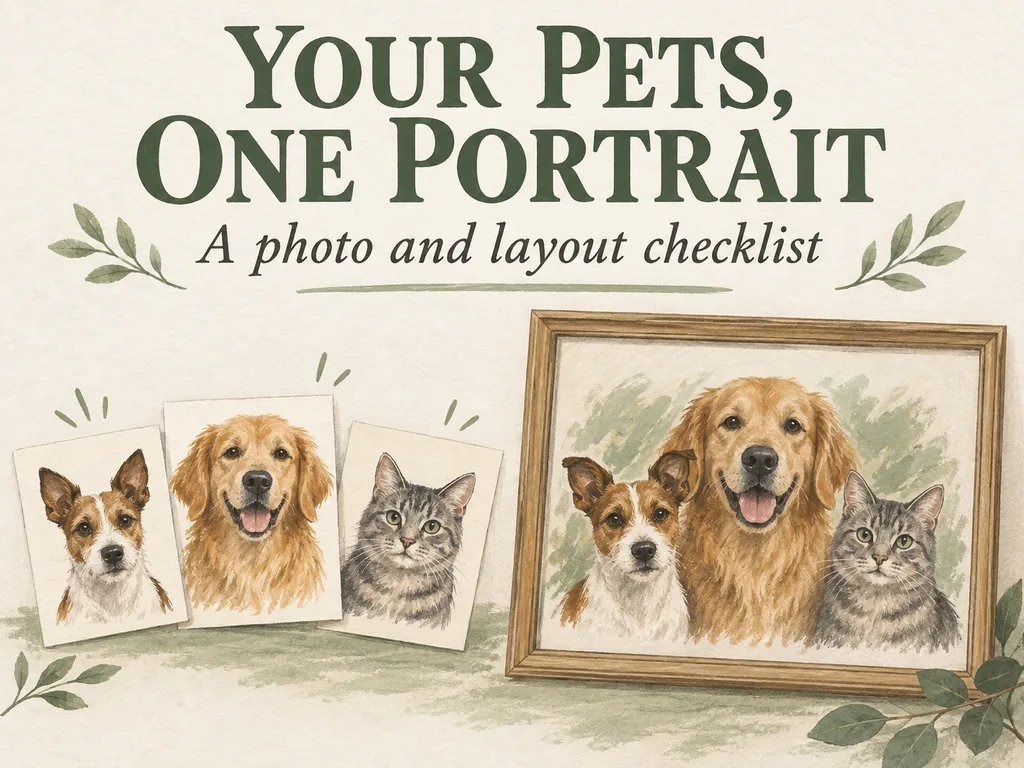
A multiple-pet portrait can be made from separate photos when the chosen artist or service supports it. Prepare one main reference for each pet, label the files, and explain where each animal belongs in the finished piece. You do not need to stage a group photograph just to begin the conversation.
Two photos might show one pet. Three pets might belong in one portrait or three separate pieces. Write that down before choosing files, so the maker does not have to guess what you are ordering.
First, specify the pets and the finished pieces
Write down how many animals should appear and how many finished items you want. For example: "Three pets together in one landscape print" is clearer than "a three-photo portrait."
Artist Jonny Atkinson describes a three-dog commission made from individual photographs, with size and position adjusted for the composition. Other services have their own requirements; ask whether yours accepts separate references for the piece you want.
Also confirm the supported number of pets and what you will receive: a digital file, an unframed print or a framed artwork. Settle those details before planning every position.
Make a small reference set for each pet
Choose a main photo and useful detail photos
Start with a picture that shows the expression and pose you want. Look for visible eyes, ears and distinctive markings. A second image can explain a white chest patch or a coat color that is difficult to see in the first; label what that extra image is meant to show.
In her account of a multi-dog commission, Amy Elizabeth Fine Art discusses using additional photos for detail. She also advises choosing similar angles and lighting when working from separate photographs. Treat that as useful preparation, not a reason to discard your only picture of a pet.
Our guide to choosing a pet photo explains what to look for before cropping. Keep the original file, and check the actual service's requirements rather than using a universal resolution or file-size rule.
Name the files without changing the originals
Work with copies. A name such as wren-main.jpg is more helpful than IMG_8246.jpg when several animals are involved. Use wren-chest-detail.jpg for a supporting image, and explain that both files show Wren.
Renaming a file does not change its format. Keep the real extension and use a supported export option if the service requires another format. Do not put every photo into one flattened collage unless the seller asks for that; individual files preserve the references separately.
Give the layout a clear left and right
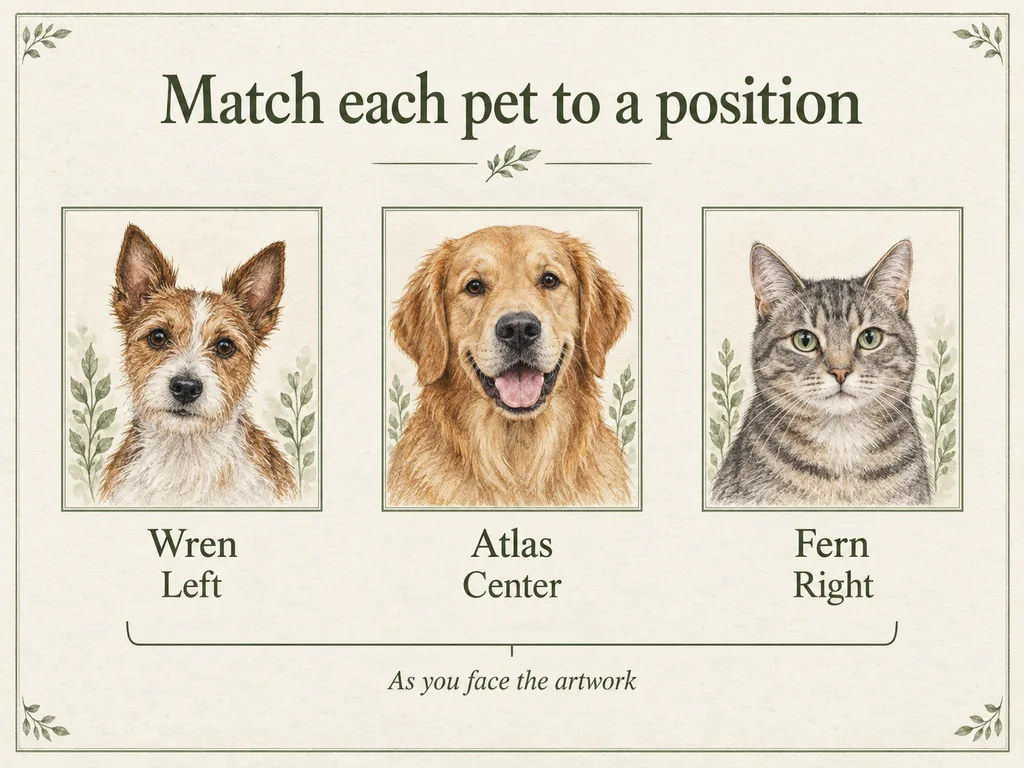
Describe positions as you face the finished artwork. If you write "Wren on the left," say whose left you mean. A quick labeled sketch can carry the same information without requiring drawing skill.
Here is an invented example for a household with two dogs and a cat:
| Pet | Main reference copy | Position as you face the artwork | Detail to preserve |
|---|---|---|---|
| Wren | wren-main.jpg | Left | Upright ears and white muzzle |
| Atlas | atlas-main.jpg | Center | Floppy ears and golden coat |
| Fern | fern-main.jpg | Right | Tabby forehead markings |
Replace the names and details with your own. If two pets have similar coloring, the file labels become especially useful. Tell the maker which extra pictures belong to which pet rather than expecting them to infer the pairing.
Decide how size should work
For a full-body composition, say whether you want the animals' real size differences reflected. A small dog photographed close to the camera can fill more of its source image than a larger dog photographed farther away. Those separate frames do not establish the pets' relative sizes.
You can describe the difference in ordinary language or supply a useful existing group picture as an additional reference. If the artist needs measurements, ask which ones would help rather than inventing a scale from the photographs.
In a head-and-shoulders layout, you might prefer each face to have similar space. Say so, especially if one animal is much larger in life. Otherwise, "make them equally prominent" leaves the maker to decide what you mean.
Choose one shared piece or a matching set
Would you rather see everyone in one frame, or have a separate picture for each pet? With individual portraits, you can change their arrangement later. A shared composition keeps the grouping in one piece.
Consider the space available and whether one animal's reference is much more tightly cropped than the others. For a set, confirm the visible image sizes, orientation and what is included with each piece. Matching outer frames alone do not tell you how large the portraits inside will be.
If this is a gift, ask whether the recipient wants a group portrait at all. They may prefer two individual pictures, or a smaller object rather than wall art. Our personalized pet gift guide starts with how the person would actually use or display the gift.
Send a short brief, then check the actual service
You can adapt this original example:
I'd like one landscape portrait showing Wren, Atlas and Fern. As I face the artwork: Wren left, Atlas center, Fern right. The files marked “main” show the expressions I prefer; the other files show details only. Please tell me whether these references work for your service and how to specify their relative sizes.
Add the desired medium and whether names should appear in the artwork. Check the price for the selected pet count, the number of files accepted, and how to submit extra references. A service that accepts several uploads may still have a limit on the number of animals in one design.
Find out whether the order includes a layout proof and what can be changed. Do not assume a free preview, unlimited revisions or a customer-approval stage simply because another seller offers one.
When one pet has only older photos
Share the best existing files and explain which details are uncertain. If a photograph never shows a particular marking or ear shape, do not present an imagined reconstruction as an accurate reference.
Ask what the available material supports. The answer may be a different crop, a simpler treatment or separate portraits. You do not need to manufacture a new photograph of pets who were never together.
For pets who are with you now, keep a few clear pictures when you happen to take them. These everyday pet memory ideas suggest ways to save pictures with a short note about the moment.
Before you submit
Open the files once more and read the brief alongside them. Does each name point to the right pet? Are the positions written from the viewer's side? Check any words to be printed, the intended size differences and the number of finished items. Keep a copy of what you send.
Dogs and cats can be part of the same planned composition, but the chosen service must support that combination. If one reference is less clear than the others, ask about it before ordering rather than assuming the final artwork will recover detail the file does not contain.